
Policy Paper
Social Impact


“Demography is destiny.” Auguste Comte
PART I
The Bomb: A Crisis Hiding Behind the Wrong Number
Let’s start with a fact that sounds like good news. Africa's youth unemployment rate; roughly 15–18%; is frequently lower than Southern Europe's. At the peak of the eurozone crisis, Spain and Greece exceeded 50%. Judged by the number the world watches, Africa has no exceptional problem at all.
That is precisely the trap. The unemployment rate is an instrument designed for economies with formal labor markets, unemployment insurance, and a meaningful distinction between having a job and not having one. Point it at Africa and it measures almost nothing. Nearly three-quarters of African jobs are informal. Close to half of employed youth live on under $3 a day. Underemployment has climbed steadily since 2015, passing 40% by 2024. The crisis is not that young Africans don't work. It is that work does not pay, does not protect, and does not lead anywhere.
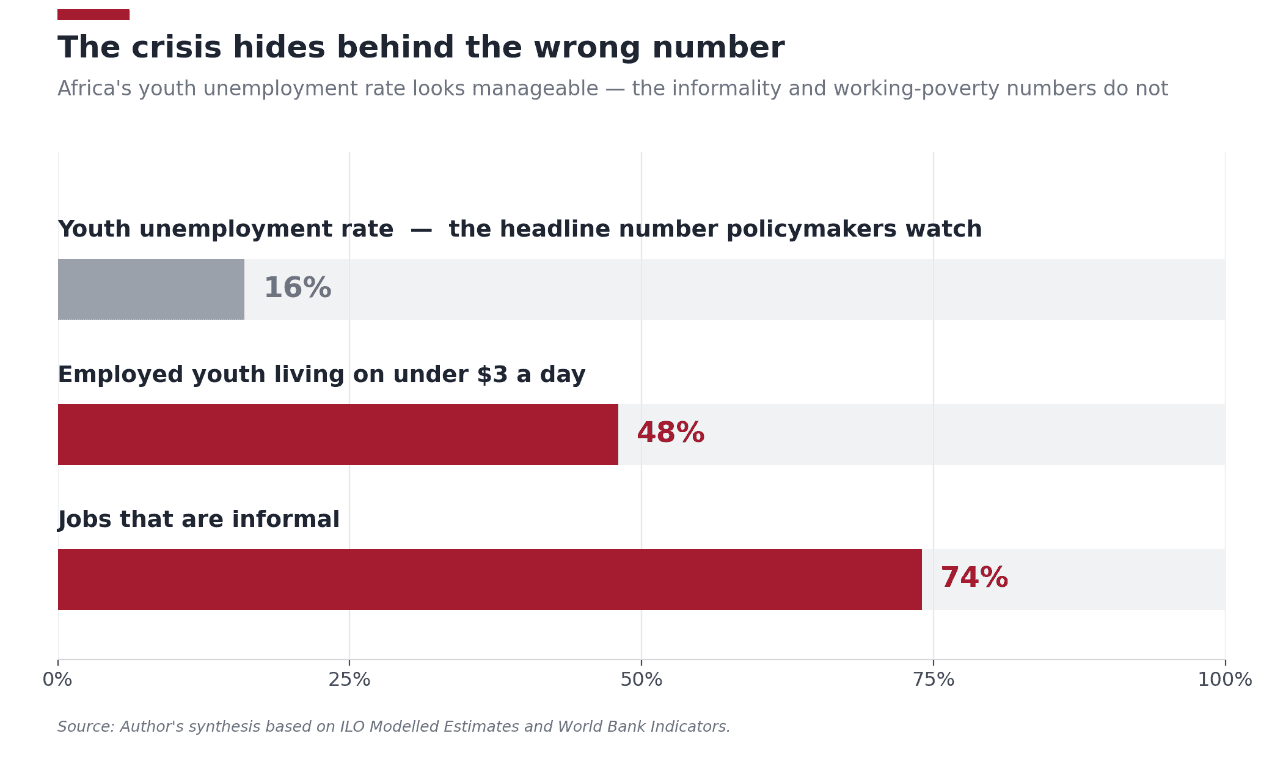
Figure 1. The unemployment rate (the number that drives policy attention) is the smallest and least informative of the three.
Nigeria and Ghana show what the aggregate hides. In Nigeria, technology and fintech drive a fifth of GDP growth while 85% of graduates lack the basic digital competencies for entry-level roles; construction firms import foreign technicians while diploma-holders queue. In Ghana, nearly 60% of 300,000 annual graduates fail to find stable work, cycling through unpaid internships while universities keep producing for a labor market that existed a generation ago.
THE SCALE OF THE QUAKE
Twelve to fifteen million young Africans enter the labor market every year. Absorbing them would require roughly one million new formal jobs every month — sustained for twenty-five years. No region has ever done this. And the denominator keeps growing: between 2025 and 2050, Africa will add approximately 667 million working-age people. The European Union's entire labor force is about 222 million. Africa will add three EUs' worth of workers in the time it takes today's newborns to finish university.
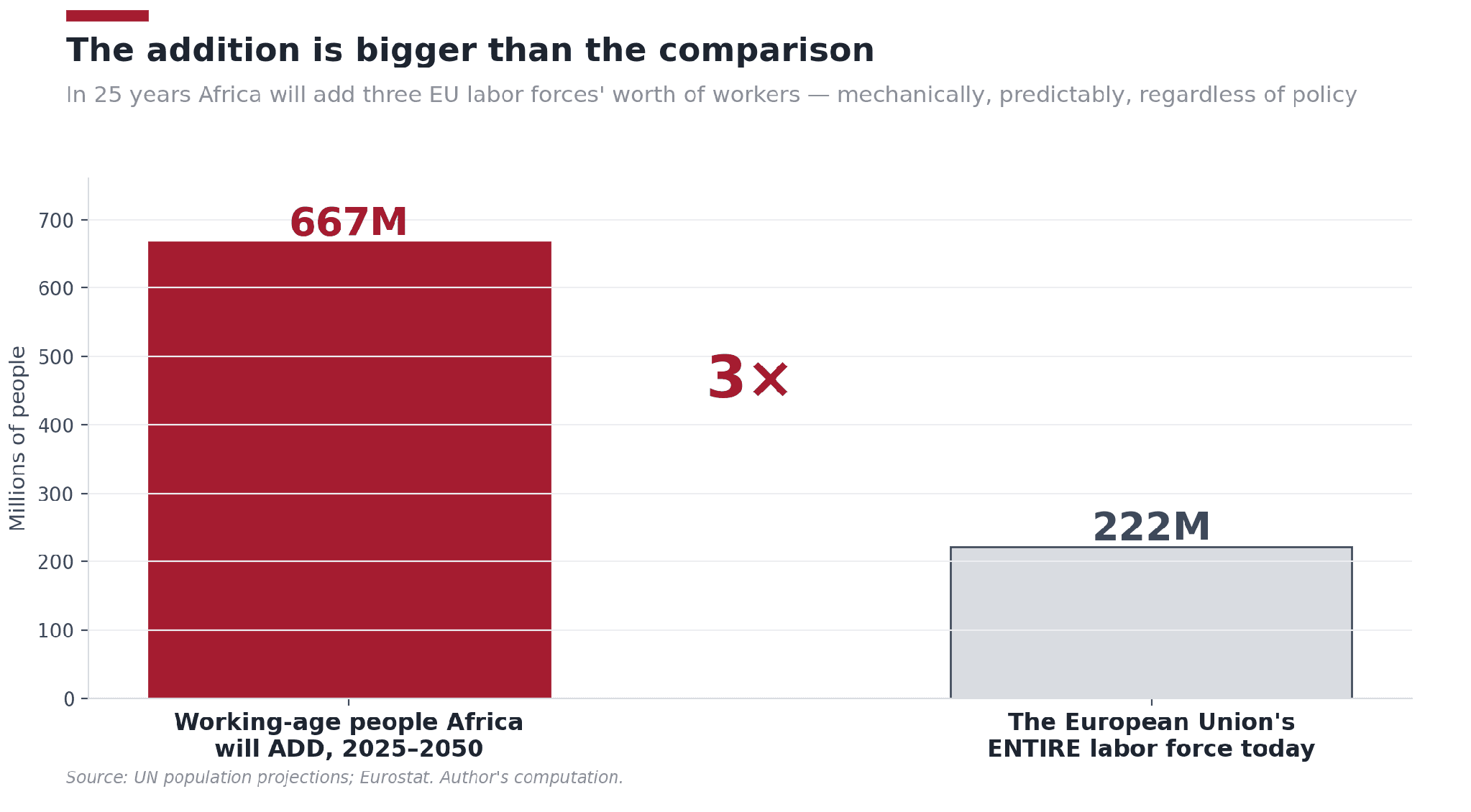
Figure 2. Projections of workforce addition. These people are already born. The expansion is mechanical and it accelerates until 2045–2050.
One more feature makes this decade different: the shock arrives into a weakened support system. Debt-to-GDP ratios across the continent have risen sharply, crowding out public investment and raising borrowing costs exactly when job creation needs both, while the donor ecosystem that cushioned earlier crises is retrenching. The bomb is bigger, and the bomb squad is smaller.
PART II
The Blast Radius: Where the Pressure Goes
Pressure of this magnitude does not dissipate. It routes. Follow the frustrated energy of a jobless generation and it flows down four channels each of which has already stopped being hypothetical.
CHANNEL ONE: THE COUP BELT
The map of recent coups and the map of the youth bulge are nearly the same map. Where the median citizen is a teenager and the formal economy offers him nothing, the military becomes the one institution that provides salary, structure, and status and the constituency for constitutional patience evaporates. Young populations did not cause the Sahel's coups by themselves, but they supplied the permission structure: crowds cheering soldiers are, demographically, crowds of young men the system failed first.
CHANNEL TWO: ARMED GROUPS AS EMPLOYERS
Insurgencies in the Sahel and the Horn function, in cold economic terms, as employers of last resort; offering pay, purpose, and protection to young men with no competing offer. Counterterrorism strategy that ignores the labor-market substructure is treating the symptom armed, so to speak. Every year the job gap compounds, recruitment gets cheaper.
CHANNEL THREE: MIGRATION AS A SELECTION FILTER
The migration route skims from the top. African migrants who reach Europe are more than twice as likely to hold a university degree as the populations they leave behind. Hold that against the skills narrative for a moment: the continent supposedly starved of skilled labor is a net exporter of it. Migration is not a random overflow of the desperate; it is a selection filter removing precisely the human capital the conventional diagnosis says is missing. This single fact should have killed the skills story years ago. Part III returns to it.
CHANNEL FOUR: THE EUROPEAN FEEDBACK LOOP
And the pressure does not stop at the Mediterranean. Over the past decade, migration politics has become a decisive variable in European elections in the United Kingdom, Germany, Greece, and Italy, parties campaigning on migration control have won or anchored governments repeatedly since 2010. Whatever one's politics, the structural point is neutral and profound: the state of Africa's labor markets is now an input into European electoral outcomes. This is what elevates a development problem into a geopolitical one. Europe is a stakeholder in African job creation whether it chooses to be or not; the only choice is whether it participates upstream, in the labor market, or downstream, at the border.
Europe will engage with Africa's job gap either in its factories or at its fences.
PART III
The Misdiagnosis: Why the System Keeps Failing
If the crisis is this legible, why has a generation of policy failed against it? Because the dominant diagnosis is wrong, and the systems built on that diagnosis fail by design. Four exhibits.
EXHIBIT ONE: THE SKILLS STORY DOES NOT SURVIVE THE DATA
The reigning theory says young Africans lack the right skills. If that were true, education would predict employment. It does not. Across 50+ African countries, there is no protective relationship between tertiary attainment and youth unemployment — the fitted line slopes the wrong way.
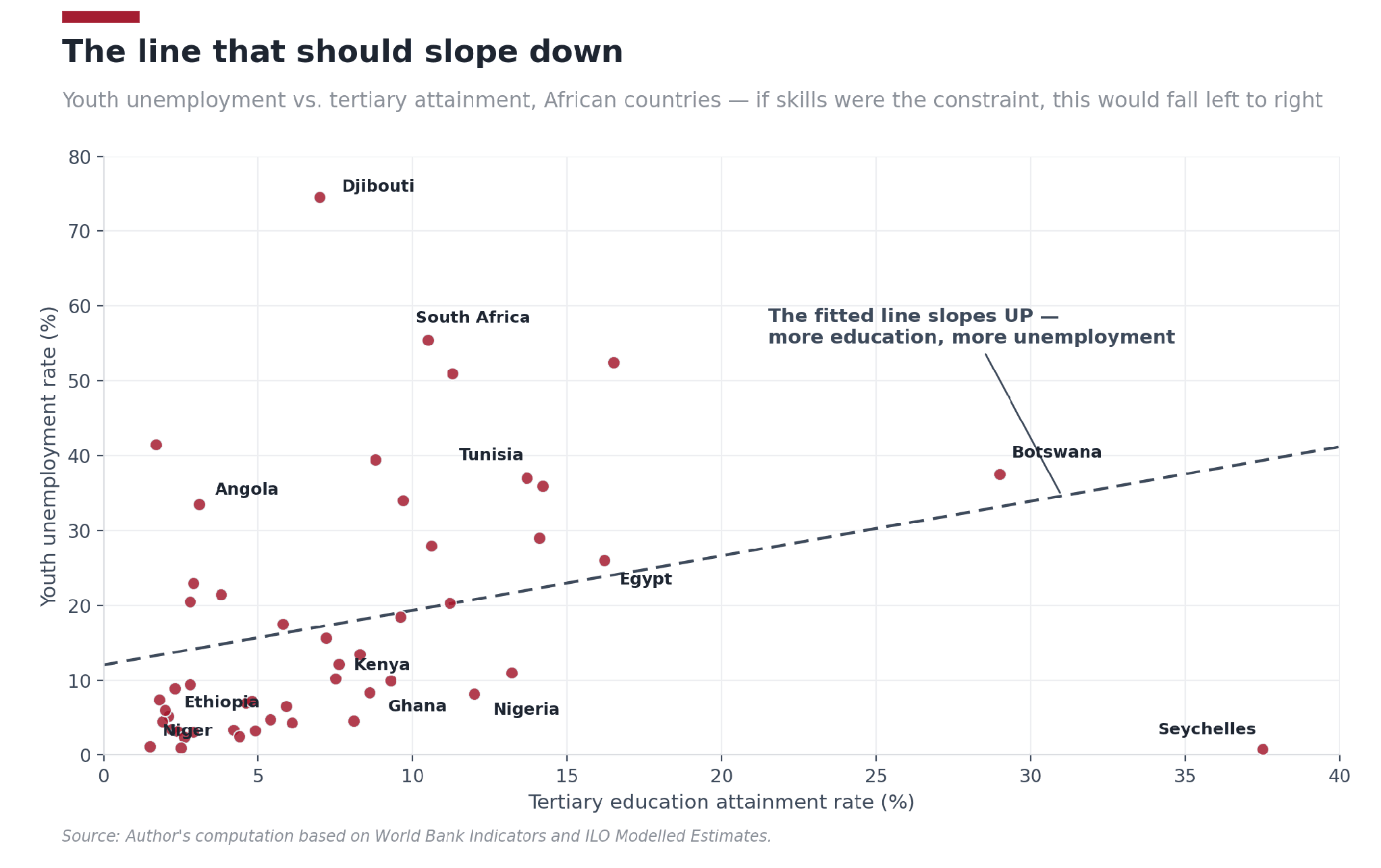
Figure 3. If skills were the binding constraint, this line would fall from left to right. It rises.
Within countries, the pattern sharpens into indictment. In Egypt, Senegal, and Zambia, unemployment among youth with advanced education exceeds 40%; five to eight times the rate of those with no schooling. The staircase repeats in Burkina Faso, Malawi, Rwanda, Tanzania: every additional level of education buys more unemployment, not less.

Figure 4. The grey dot marks unemployment with no schooling; the crimson line climbs with each additional level of education.
The binding-constraint test settles it. Genuinely scarce skilled labor produces two signatures: a large wage premium for skills, and firms importing talent. Africa shows neither — premia are modest, and skilled labor flows out (recall the migration filter of Part II).
You do not have a shortage of something you are shipping abroad.
The constraint is not the supply of skills. It is the demand for labor. Everything else follows from getting this one sentence right.
EXHIBIT TWO: THE ENTREPRENEURSHIP ARITHMETIC
The reflexive alternative, “youth entrepreneurship”, collapses on contact with arithmetic.
THE ENTREPRENEURSHIP ARITHMETIC

Nine million startups a year, indefinitely. No economy in history has founded its way out of a structural deficit.
The economies that did absorb youth bulges; South Korea circa 1990 and China circa 2000 had firm distributions dominated by medium and large enterprises. Africa's is inverted: micro-enterprises make up 40–57% of firms in Ethiopia, Ghana, Kenya, Nigeria, and Tanzania. Historically, entrepreneurship ecosystems grew downstream of factories from outsourcing demand, spillover know-how, and factory workers' household consumption. Entrepreneurship is the child of industrialization, not its substitute.
EXHIBIT THREE: BANKS FINANCE CONSUMPTION, NOT JOBS
Across Nigeria, Tanzania, Kenya, Ghana, and Côte d'Ivoire, the single largest allocation of bank credit; 26–36% is consumer and personal lending; with trade finance, roughly half of banking-system credit funds consumption and imports rather than production. Manufacturing, the sector with the highest employment multiplier, is systematically starved.
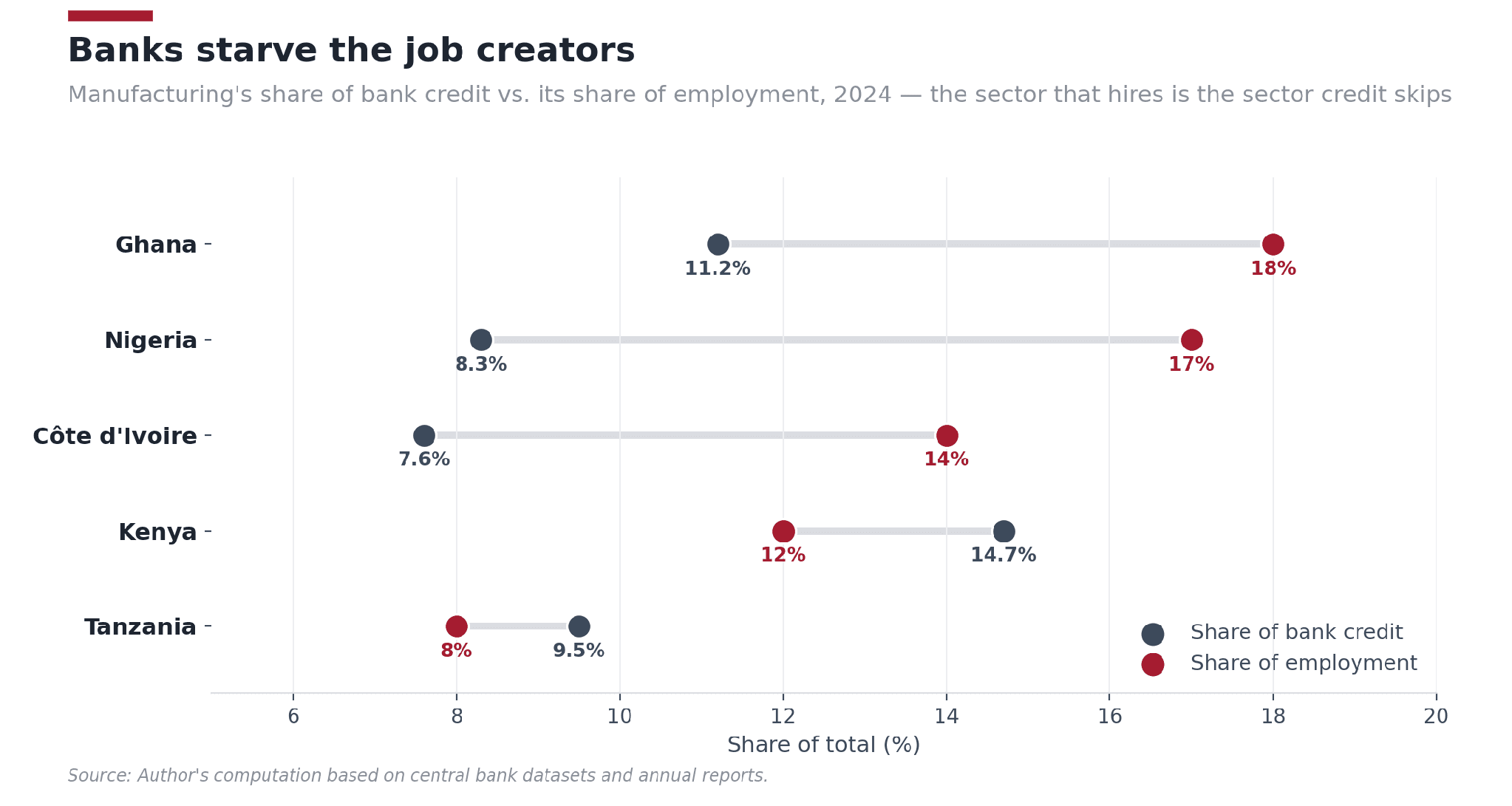
Figure 5. The distance between the dots is the market failure: where manufacturing employs the most, it borrows the least.
Each bank is behaving rationally: short-tenor, collateralized, salary-backed lending is safer — but the aggregate outcome is a financial system structurally indifferent to job creation. The firm life cycle compounds it: commercial banks enter only at the mature phase, while the early and scale-up stages that actually create jobs depend on angel capital, venture capital, and growth equity — asset classes that barely exist at scale on the continent.
EXHIBIT FOUR: GROWTH OF THE WRONG SHAPE
The last refuge of orthodoxy is “just grow faster.” But Africa's growth engines such as mining, telecoms, finance are capital-intensive by design, producing GDP without payrolls; agriculture and informal trade hold the jobs. Run the scenarios: at 3% growth, roughly 1 million employment-intensity-adjusted jobs materialize; at a heroic 8%, fewer than 3 million against 12 million entrants. Even the best case strands three-quarters of the cohort.
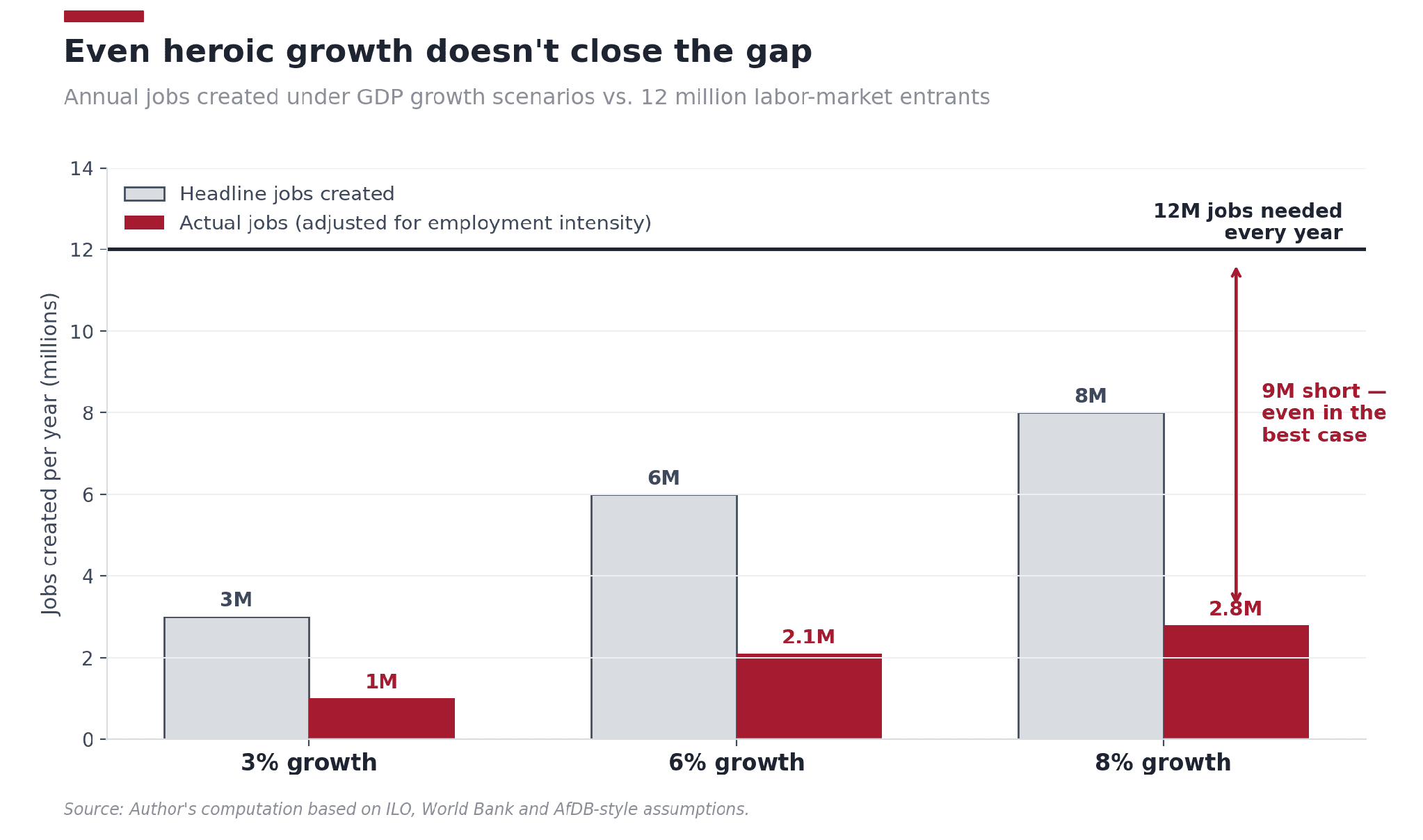
Figure 6. The white space between the tallest bar and the black line is the whole argument. Growth is necessary. It is not sufficient.
PART IV
The Narrow Path: Uncomfortable Solutions
Here is what makes this genuinely hard rather than merely neglected: the toolkit that built Korea's and China's labor-absorbing firms is largely illegal now. Directed credit, infant-industry protection, trade-related performance requirements on foreign investment, technology acquisition through reverse engineering, managed exchange rates, state coordination of investment, procurement as demand creation seven instruments, all of them central to every successful late industrialization on record, all now constrained by WTO rules, investment treaties, and fiscal arithmetic. Africa faces history's largest youth cohort with history's narrowest policy arsenal.
So the honest conversation begins with stakeholders, not slogans. Four parties own this problem: African youth, who bear it; African governments, who must redesign around it; European governments, who —per Part II — will pay for failure either upstream or downstream; and the development community, whose prevailing playbook Part III just retired. Any framework that assigns responsibility to fewer than all four is posturing.
FIVE IDEAS IN PROGRESS
First, productivity reframes. If three-quarters of work is informal, raising productivity inside informal and agricultural work is not a consolation prize; it is the largest single lever, and the fastest route from $3 a day to a living income.
Second, demographic-linked industrial policy. Make labor absorption an explicit design criterion of economic strategy; sectors chosen, credit steered, and incentives priced by jobs per unit of capital, not GDP alone; using whatever policy space remains rather than mourning what is gone.
Third, relocation as a complement. Managed labor mobility; regional and intercontinental; treated as a legitimate instrument rather than a betrayal. The workers are already moving; the only question is whether the channel is designed or improvised, legal or lethal.
Fourth, AfCFTA leverage. The single strongest answer to the demand problem: continental market scale is what makes medium-sized firms — the missing middle of Part III — viable. A firm too big for a village and too small for the world needs a continent.
Fifth, an adequate financing chain. Build the full ladder: angel, venture, growth equity, then banks — so firms can climb from founding to scale without falling into the gap between a microloan and a corporate bond.
DEMOGRAPHY IS NOT DESTINY
The seminar that shaped this series opens every session with Comte: demography is destiny. Read one way, it is fatalism the cohort is born, the wave will land. But the data assembled here supports a sharper reading. Demography sets the size of the test, not the grade. South Korea and China faced their own youthquakes and converted them into the largest economic ascents in history, because policy treated the cohort as the asset it was. Africa's 667 million are the same test. Demography is destiny only on autopilot. The whole point of the next twenty-five years is to switch off the autopilot, and the clock, unlike the policy debate, compounds.
This essay synthesizes the four-session HKS seminar “Youthquake: Africa's Jobless Generation - A Geopolitical Ticking Bomb,” with thanks to Dr. Agou Gomez for guidance, and analysis developed under the MESA Institute fellowship. Data: World Bank Indicators, ILO Modelled Estimates, UN population projections, Eurostat, national central bank reports, enterprise surveys and OECD datasets, and author's computations.
FIND MORE