
Technological Frontiers
Policy Paper


While Latin America and the Caribbean (LAC) has experienced significant gains in digital infrastructure and access over the past decade, persistent gaps in speed, affordability, and infrastructure quality continue to undermine the region's potential (Castellanos, 2023). The region remains fragmented in digital connectivity and uptake along socioeconomic and geographic lines, limiting rural, indigenous, and lower income communities’ access to technologies. Closing access gaps remains critical for building a resilient digital public infrastructure - defined by the OECD as “shared digital systems that are secure and interoperable and that can support the inclusive delivery of and access to public and private services” (2024), maintaining the region’s global competitiveness, and protecting local and digital rights.
Internationally, the digital world is dominated by a concentrated group of U.S.-based technology companies. Nearly 70% of the global cloud market is controlled by Amazon, Microsoft, and Google, and “over half of the world’s undersea cables once Meta is included” (Rikap et al., 2024, p. 5). This hyper-concentration of digital power compromises countries’ ability to develop and maintain digital sovereignty, most disadvantageous to the Global South. In practice, this technological monopoly reinforces LAC’s dependence on U.S. technology and limits the region’s agency in controlling digital infrastructure and data (Rikap et al., 2024).
Strengthening digital sovereignty is critical for LAC to close access gaps both within the region and among the rest of the world. Despite notable gains including the doubling of digital connectivity in the past decade (Castellanos, 2023), Latin America risks falling further behind global standards in broadband access, cloud capacity, digital literacy, and other critical infrastructure. For instance, the region increased fixed broadband penetration from 3.5% of the population in 2007 to 18% in 2023 compared to an increase from 19.7% to 39% in the European Union (CEPAL, 2025).
Figure 1: Percentage growth in high-speed fixed internet penetration, countries and world regions, 2008-2023
Penetration: Fixed broadband subscriptions per 100 inhabitants (%)
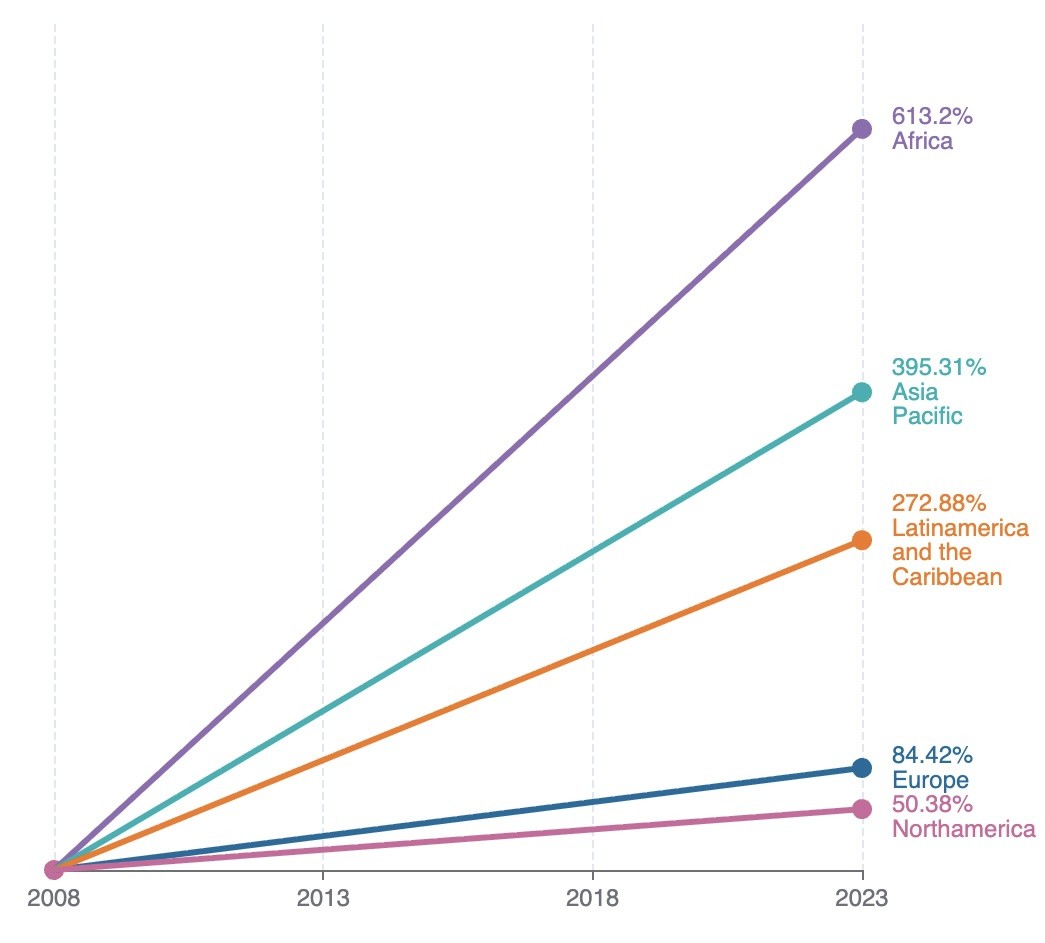
Source: own elaboration based on World Telecommunication/ICT Indicators Database July 2023, International Telecommunication Union (ITU) and ECLAC, 2000 to 2022.
Although LAC observed a relative growth of 272.88% in fixed broadband subscriptions from 2008 to 2023 (Figure 1), the overall level of subscription remains one of the lowest in the world at 17.87% of inhabitants (Figure 2).
Figure 2: High-speed fixed internet penetration, countries and world regions, 2007-2022
Penetration: Fixed broadband subscriptions per 100 inhabitants (%)
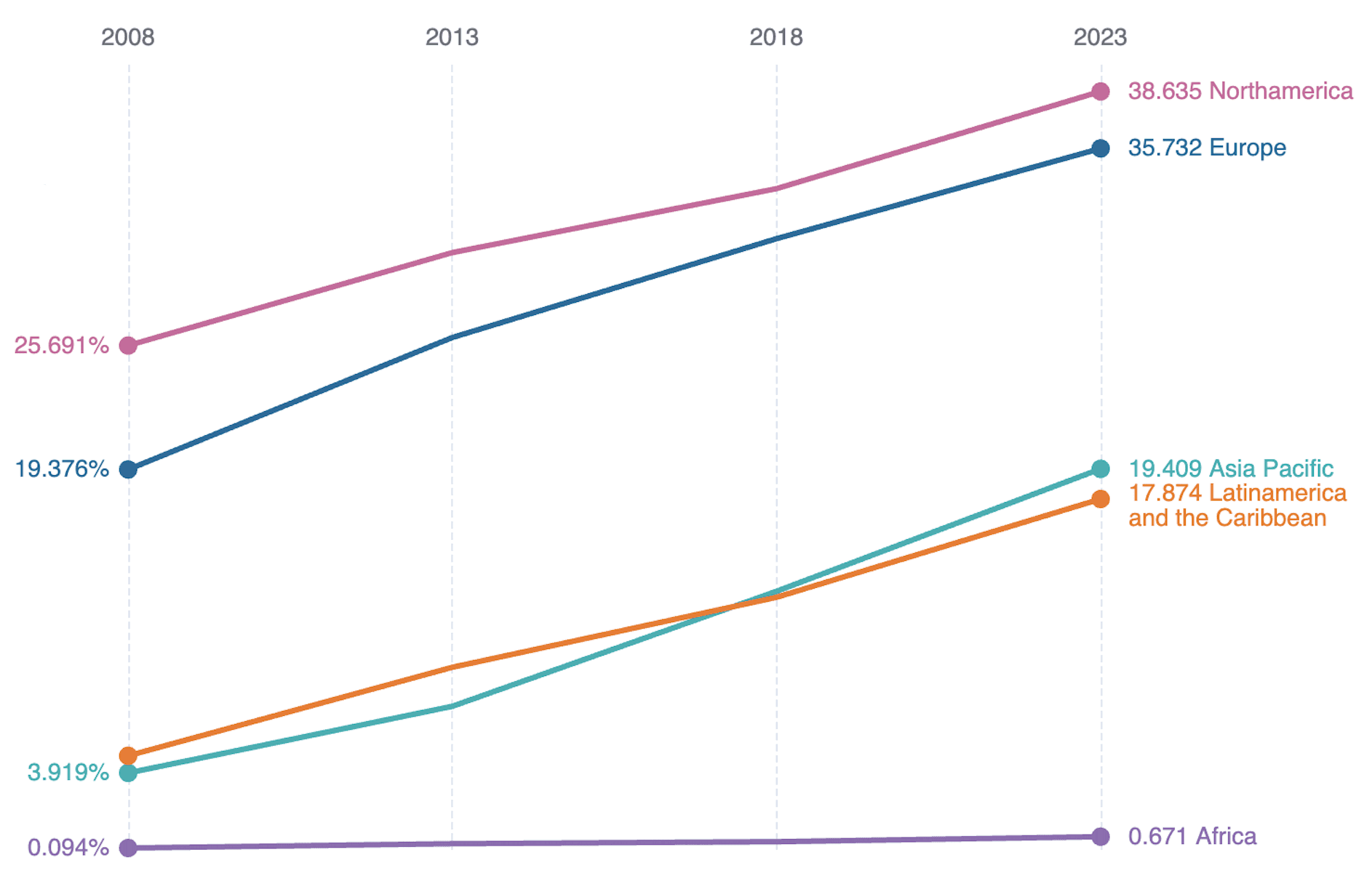
Source: own elaboration based on World Telecommunication/ICT Indicators Database July 2023, International Telecommunication Union (ITU) and ECLAC, 2000 to 2022.
Gaps between LAC and other regions persist when evaluating digital access disparities occurring along class lines. The region achieved under 40% progress to class digital parity as of 2023, lagging “behind all other regions, both on an absolute basis and in making the least progress in both the past decade (10 percentage point improvement) and the last three years (less than one percentage point)” (Chakravorti et al, 2025, p. 32). Limitations in digital parity translate to reduced gender digital inclusion and greater rural-urban divides.
Figure 3: Progress to Class Digital Parity by Region
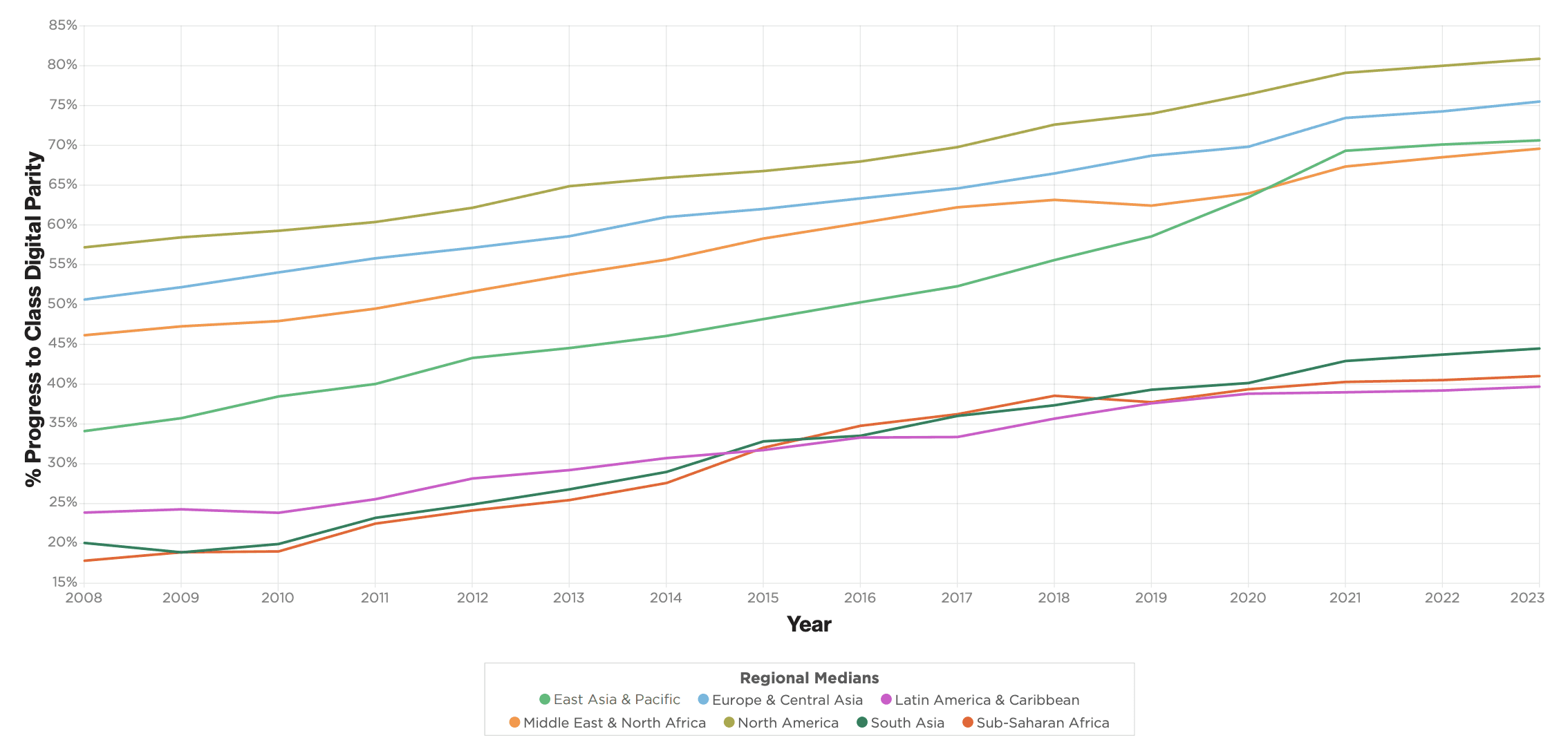
Source: Chakravorti, B., Chaturvedi, R. S., Filipovic, C., & Niu, X. (2025). (rep.). Digital Planet 2025. From the COVID Shock to the AI Surge: How 125 Digital Economies Around the World Are Evolving and Changing. The Fletcher School at Tufts University.
LAC’s global positioning in digital access can be partly attributed to its limited inclusive growth. Digital uptake has not been accessible to all demographics, particularly lower-income groups, due to the high costs of data plans and devices and limited infrastructure in rural areas (Economist Impact, 2025). In Latin America, a mobile data plan of only one GB costs, on average, 2.7% of monthly household income, exceeding the United Nations' 2% affordability benchmark (Drees-Gross & Zhang, 2021). Although internet users in LAC accounted for over 80% of the region’s population in 2023 (ITU, 2024), gaps in internet access between the highest and lowest income quintiles reach up to 50 percentage points (Figure 4).
Figure 4: Latin America and the Caribbean: shares of households with Internet access, by income quintile, 2018-2022 (Percentages)

Source: Economic Commission for Latin America and the Caribbean (ECLAC), Household Survey Data Bank (BADEHOG)
Rural and indigenous communities are disproportionately excluded from reliable phone signal and broadband, as seen in Honduras where only 20% of the rural population used the internet in 2019 compared to 55% of urban residents (Internet Society).
Rural broadband deserts, lagging cloud capacity, low digital literacy, and limited local content serve as barriers to inclusive digital access, but also contribute to educational divides, productivity gaps, and disparities in information access. Digital exclusion often compounds existing inequality, exacerbating class and racial disparities. Accessing digital spaces has become essential for receiving climate alerts and election information, acquiring welfare benefits, finding labor opportunities, and more. LAC must therefore strive to achieve meaningful connectivity which expands beyond internet access to include “quality, affordability and skills needed for people to be able to fully benefit from digital opportunities” (CEPAL, 2024).
In addressing these disparities, the region must also combat challenges with overarching infrastructure limitations. Currently, LAC “hosts less than 5% of the world’s data center infrastructure and lacks China’s massive computational ability” (Economist Impact, 2025). Relying on servers across the world, LAC stores and processes data on foreign land and therefore limits digital sovereignty.
Effectively addressing these gaps presents a significant opportunity for the region. Expanding access to high-quality connectivity would not only improve digital inclusion but also generate broader economic gains. Research suggests that a 10% increase in mobile broadband speed is associated with a 0.2% increase in labor productivity on average, with particularly strong effects in lower-income economies (Edquist, 2022). Investments in broadband infrastructure, affordability, and digital skills can therefore serve as catalysts for productivity growth, workforce participation, and economic resilience across Latin America and the Caribbean.
Closing connectivity gaps is also increasingly important as artificial intelligence reshapes economies and public services worldwide. While policymakers across the region identify inadequate digital infrastructure and insufficient investment as primary barriers to AI adoption (Economist Impact, 2025), Latin America and the Caribbean possesses important comparative advantages. For instance, the region generates a higher share of electricity from clean energy sources than the global average, creating favorable conditions for the development of energy-intensive digital and AI infrastructure (Ember, 2026). The region’s high potential for hosting digital infrastructure could meet demand for improved connectivity. 45% of AI users in Latin America report that better access to high-speed internet would make AI tools more useful to them, compared with 29% of users in high-income countries (Economist Impact, 2025). LAC’s advantages warrant strategic policy action to strengthen digital infrastructure and, in turn, optimize technological outcomes benefitting diverse regional goals.
Digital infrastructure is no longer simply a matter of connectivity - it has become a prerequisite for economic development, democratic participation, and digital sovereignty. As global digital power becomes increasingly concentrated among a small number of foreign firms, Latin America and the Caribbean faces a choice between remaining dependent on external digital systems or investing in the infrastructure, governance frameworks, and local capacity necessary to shape its own digital future. The region’s approach to technological development today will shape its global influence and its residents’ connectivity and opportunity for decades to come.
References
Castellanos, D. S. (2023, September 1). Latin America’s internet penetration surpasses that of China. Bloomberg Línea. https://www.bloomberglinea.com/english/latin-americas-internet-penetration-surpasses-that-of-china/
Chakravorti, B., Chaturvedi, R. S., Filipovic, C., & Niu, X. (2025). (rep.). Digital Planet 2025. From the COVID Shock to the AI Surge: How 125 Digital Economies Around the World Are Evolving and Changing. The Fletcher School at Tufts University. Retrieved from https://digitalplanet.tufts.edu//wp-content/uploads/2025/dei/Digital-Evolution-Index-2025.pdf.
Comisión Económica para América Latina (CEPAL). (2025, March 7). Latin America and the Caribbean: Among the Regions with the Lowest Fixed Broadband Penetration Worldwide. https://desarrollodigital.cepal.org/en/data-and-facts/latin-america-and-caribbean-among-regions-lowest-fixed-broadband-penetration
Comisión Económica para América Latina (CEPAL). (2024, November 6). A Real and Effective Digital Transformation Can Help Latin America and the Caribbean Overcome the Traps Hindering its Development. Retrieved from https://conferenciaelac.cepal.org/9/en/news/real-and-effective-digital-transformation-can-help-latin-america-and-caribbean-overcome-traps#:~:text=The%20document%20states%20that%20while,indicators%20of%20connectivity%20with%20more.
Drees-Gross, F., & Zhang, P. (2021, July 21). Less than 50% of Latin America has fixed broadband. Here are 3 ways to boost the region’s digital access. https://www.weforum.org/stories/2021/07/latin-america-caribbean-digital-access/
Economist Impact. (2025, December 11). Wired for growth? Latin America’s Digital Infrastructure Crossroads. J.P. Morgan. https://privatebank.jpmorgan.com/latam/en/insights/markets-and-investing/ideas-and-insights/wired-for-growth-latin-americas-digital-infrastructure-crossroads#f5
Edquist, H. (2022). The economic impact of mobile broadband speed. Telecommunications Policy, 46(5), 102351. https://doi.org/10.1016/j.telpol.2022.102351
Ember. (2026, June 6). Latin America and the Caribbean. https://ember-energy.org/countries-and-regions/latin-america-and-caribbean/
Internet Society. (n.d.). Honduras Country Report. Internet Society Pulse. https://pulse.internetsociety.org/en/reports/hn/
ITU (International Telecommunication Union). (2024). ITU DataHub [online database] https://datahub.itu.int/.
OECD (2024). “Digital public infrastructure for digital governments”, OECD Public Governance Policy Papers, No. 68, OECD Publishing, Paris, https://doi.org/10.1787/ff525dc8-en.
Rikap C., Durand, C., Paraná, E., Gerbaudo, P. and Marx P. (2024). Reclaiming digital sovereignty: A roadmap to build a digital stack for people and the planet. Retrieved from https://www.ucl.ac.uk/bartlett/public-purpose/Reclaiming-Digital-Sovereignty
FIND MORE