Social Impact
Policy Commentary
Concept
Two-in-one transformation:
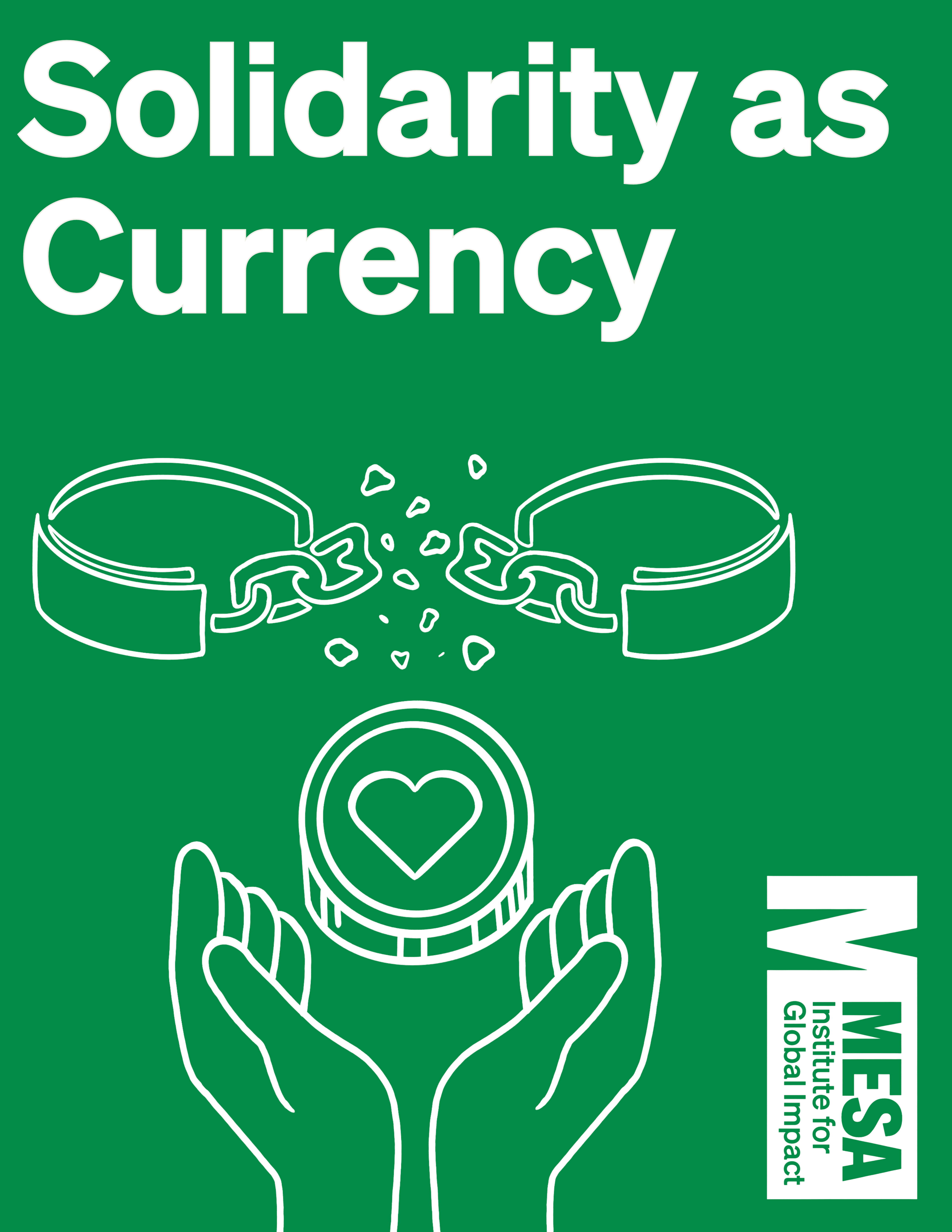
The Social Solidarity Currency establishes the premise of a new global financial order by connecting traditionally unpaid labor — acts of care, community service, and solidarity — with debt reduction mechanisms.
In this model, solidarity becomes a financially recognized action, and a debt-erasing asset. The Social Solidarity Currency does not create new money; it erases existing debt by converting verifiable acts of solidarity into quantifiable units of social value.
The Problem
Debt Overload: Global public debt surpassed $108 trillion in 2024, with developing countries carrying over $31 trillion, facing debt servicing costs that now exceed their health and education budgets.
Unrecognized Labor: The global value of unpaid care work, largely performed by women, is estimated by the ILO at $11 trillion annually, representing 9% of global GDP yet absent from formal accounting systems.
Erosion of the Social Fabric: The cultural shift toward individualism and automation weakens social cohesion, leaving civic participation undervalued and unfinanced.
The Opportunity
To monetize solidarity without commodifying it: The Social Solidarity Currency proposes an “inverse market” where acts of care and solidarity generate non-fungible debt-erasing assets, recognized through transparent valuation systems.
Each verified act contributes to:
Strengthening local social capital,
Generating measurable global public goods, and
Reducing outstanding debt obligations of communities or nations.
By harnessing the world’s unaccounted labor force ecosystem, the Social Solidarity Currency could both train solidarity and build fiscal resilience.
Mechanism
Solidarity Registry
A digital ledger (blockchain-compatible) records verified local and cross-border solidarity acts, from hosting displaced families or reforesting land to mentoring, caregiving, or contributing to open knowledge platforms.Solidarity Units
Each act generates Solidarity Units, calculated via a transparent formula combining time invested, social reach, and sustainability impact.Debt Conversion Protocol
Solidarity Units are not spent like money, they are redeemed directly to offset or restructure debt. The Social Solidarity Currency platform links public creditors, international institutions, and private actors through a transparent solidarity-based clearinghouse.Governance
A multi-stakeholder board (youth representatives, public agencies, multilateral institutions, and civic innovators) ensures certification, valuation, and ethical integrity.
Expected Outcomes
Debt Resolved in 10 Years: A proactive system aimed at resolving debt within a decade–addressing, on average, approximately $11 trillion per year.
An Opening for a New Policy Imagination: A shift toward policy design that actively seeks solutions where none appear to exist, moving beyond resignation and “no alternative” thinking.
A Tangible Pathway for Collective Action: Citizens and communities gain a concrete way to engage with the status quo through positive action, rather than cynicism, austerity, or complacency.
Revaluation of the Intangible – and of One of Humanity’s Most Natural Traits, Care: Acts of care, creativity, and solidarity gain systemic economic recognition.
A Regenerative Social Contract: Debt cycles are replaced by a self-reinforcing loop of participation, inclusion, and reciprocity.
Pilot Phases
Those pilot phases are only a suggestion.
Phase 1: Design Lab (Q1 2026)
The first phase could focus on conceptual modeling and metric design, and could be carried out in collaboration with partners such as UNCTAD, UNDP, the Expert Group on Debt, the Beyond GDP Secretariat, the World Bank Group, and/or a network of young economists. The goal is to establish the core methodology for valuing acts of solidarity, test the data model, and define how Solidarity Units can be transparently linked to measurable debt-relief outcomes.
Phase 2: Prototype (Q2 2026)
The second phase would explore formal dialogue with institutions such as the IMF and the World Bank (or others—based on suggestions emerging from the Design Lab) to test how the mechanism could be acknowledged within existing debt frameworks. A small-scale pilot could iterate on the platform’s accounting, monitoring, and conversion system—testing how acts of solidarity are translated into Solidarity Units and, in turn, into debt relief in practice, in a fluid and operational way. This could be supported through a national (or global) solidarity action program, engaging citizens nationally and worldwide in proactively demonstrating how collective participation can contribute to fiscal balance.
Phase 3: Scaling (Q3 2026)
The third phase could integrate the mechanism into broader debt-reform frameworks or, alternatively, mainstream it through widely used platforms and tools (including social media), supporting the delivery of a people-powered Agenda 2030. This stage would aim to embed the Social Solidarity Currency into daily life, leveraging global-to-local civic energy to address one of today’s most pressing challenges, debt, and to move toward a next era of global solidarity in which more sustainable systems can be designed.
More initial directions can be provided upon request.
Why Now
The global landscape presents an unprecedented opening to design financial instruments that mobilize human potential. As debt distress, social fragmentation, and automation reshape societies, the need for innovative resources that reconnect people to purpose, and to each other, has never been greater. The convergence of fiscal urgency and technological capacity creates a rare chance to reimagine collaboration itself as a form of capital.
The Hope Behind the Experiment
If we can prove that, when given the opportunity, people naturally act in solidarity, and if such acts can be recognized, measured, and amplified, then solidarity itself can become a scalable economic mechanism. This approach could inspire governments to incorporate social contribution as a legitimate pathway for public spending and debt relief, transforming solidarity from a moral impulse into a fiscal instrument for a more human global economy.
Questions?
FIND MORE