Social Impact
Policy Commentary

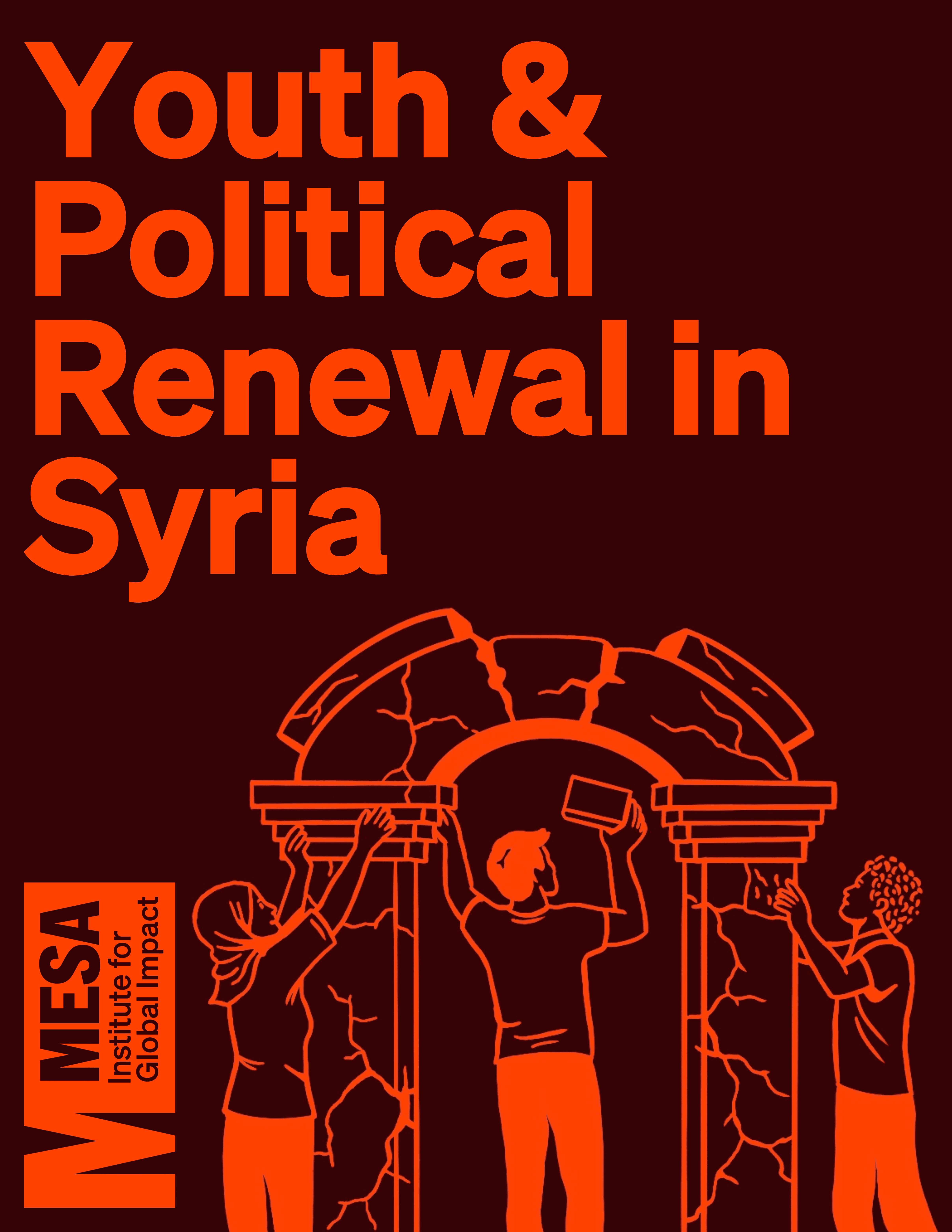
A population disenfranchised from civic and political engagement leaves little to be felt of national belonging. For many Syrians, this has been a defining reality for more than a decade. Sixty years of an oppressive dictatorship followed by fourteen years of a protracted, proxy conflict hollowed out civic space and eliminated opportunity for safe and democratic political participation, silencing many by fear and livelihood pressures. But events of December 2024 marked a turning point for the fate of the nation. The fall of the ousted Asad regime gave rise for a golden opportunity for the country to regain peace, stability, and for the Syrian people to find belonging once again. Whether this moment results in durable peace or renewed fragmentation will depend on who is included in shaping what comes next.
Syria’s youth, both locally and across the diaspora, represent an essential demographic that holds the potential to reshape the nation’s sociopolitical future. The inclusion of young people’s voices in decision making spheres is a fundamental component for preventing further social disenfranchisement, which can ultimately aid in building communal trust, generating social cohesion, and promoting political inclusion across diverse populations. In a post-conflict setting like Syria, youth engagement is even more critical for fostering peacebuilding and reconciliation, mending the damage of fear and separation inflicted upon Syrians under decades of suppression, and ensuring cycles of violence do not reproduce.
Why Youth?
Youth movements were a central force in the early revolutionary mobilization of 2011, yet their political agency steadily diminished as the conflict prolonged and was siphoned into the international arena. After fourteen years of war, a new generation of Syrian youth has emerged having grown up under vastly altered conditions, embodying differing views in the face of concepts like political participation and their role within peacebuilding mechanisms. Widespread displacement, reduced or interrupted access to education, deteriorating economic and humanitarian conditions, and persistent insecurity have all narrowed the space and will for engagement in such roles. Despite the challenges, initiative and desire to engage as social and political actors in peacebuilding and political reform still exists amongst Syrian youth. Certain limiting factors remain to be empowerment and opportunity.
Youth today are at once a vulnerable population and an untapped potential. Syrian youth remain exposed to risks of marginalization, violence, armed recruitment, interrupted education, and the burden of severe economic hardship. Yet, they are also positioned to be agents of positive change if effectively empowered and included. Amplifying youth voices, responding to their needs, and creating safe spaces for representation and genuine civic and political participation can present young Syrians as legitimate contributors to post-conflict reform, national recovery, and peacebuilding. Youth also bring innovative thinking and greater potential for broadened intercultural understanding, enabling them to challenge entrenched narratives of conflict and division. Even in similar contexts of post-conflict recovery, youth who were included in decision making and peace processes were successful at transforming community relations and entire social contracts. This is where the transformative value of youth lies: not simply as beneficiaries of peace, but as contributing architects of a new political order.
These perspectives are increasingly reflected in international policy frameworks, including the 2015 UN Security Council Resolution 2250 on Youth, Peace, and Security (YPS), which recognizes the essential role of youth in conflict prevention, resolution, and in sustaining peace; though implementation progress remains slow.
A Fragmented Landscape
Despite strong motivation amongst many Syrian youth to engage politically, this generation faces unprecedented challenges in doing so. A landscape fractured by conflict, mass displacement, and divergent lived experiences, particularly between youth inside Syria and those in the diaspora, undermines the cohesive environment needed to build effective pathways towards political and civic participation. Local youth, including those from internally displaced populations (IDPs), face significant challenges in the aftermath of conflict, grappling with uncertainty and ongoing economic and humanitarian hardships. Such circumstances often require focus on fulfilling basic needs and limit opportunities for meaningful participation in civic and political activities. Furthermore, socioeconomic disparities cause additional stratification amongst local youth themselves, visible in access to employment, education, healthcare, safety, and overall well-being. In contrast, diaspora youth are shaped by the political and social cultures of their host countries and often can feel, and be seen as, distanced (despite how involuntarily) from local realities and perspectives.
Yet, across these divides exists a shared desire for reintegration, participation, and contribution to Syria’s reconstruction and reform. Treating these groups as disconnected constituencies risks weakening peacebuilding efforts; bridging them offers a far more effective and resilient foundation for change.
Barriers to Engagement
Youth are among the most vital groups to engage within national and international political landscapes, yet they continue to face significant barriers to participation. These include a lack of safe spaces for political engagement, deep mistrust of governing institutions, inherited political trauma from decades of suppression, exclusion, control, and inflicted subregional or identity-based divisions. Many young Syrians remain hesitant to participate due to fear and uncertainty about whether civic and political engagement is truly safe and even effective.
Studies prior to December 8th assessing Syrian youth perceptions of political participation (OPC, The Day After) revealed high interest but consistently low engagement. While nearly half of Syrian youth expressed interest in the public sphere, many viewed political participation as a risky endeavor with potential consequences. Addressing this gap requires more than formal inclusion; it necessitates psychosocial reworking, restorative practices, and trust-building measures that allow youth to unlearn political fear and reimagine participation as safe, legitimate, and impactful.
Moving Forward: Bridging Local and Diaspora Youth
Local youth possess invaluable insights into community needs and post-conflict conditions, while diaspora youth contribute a range of acquired skills, global networks, and access to international institutions and resources. Promoting dialogue, structured collaboration, and joint initiatives between these groups can improve the effectiveness, sustainability, and innovation of peacebuilding endeavors. The diaspora may serve as a bridge, strengthening local youth-led efforts by sharing methodologies, facilitating training opportunities, and elevating Syrian priorities in international arenas.
Strategic efforts should prioritize the development of trusted, participatory platforms that foster exchange across geographic and social boundaries. Initiating engagement by identifying capable youth representatives and equipping them with technical expertise, resources, and secure platforms can produce meaningful local impact while cultivating confidence in wider national and international political participation.
The creation of youth coalitions can be an example of one such strategy. These bodies should be formal, inclusive, and operate across local, national, and international levels, connecting the progress of youth inside Syria with efforts waged abroad by the diaspora. Such platforms would assist Youth in being active participants in designing relevant solutions and policies that impact their lived realities. Similar national coalitions on YPS have already been establish in both Jordan and Iraq as part of implementation of their YPS national strategies and that of the League of Arab Nations’ YPS strategy, which Syrian stakeholders can benefit from referencing.
As safety and national belonging are restored, youth participation in local councils and governance structures must become an accessible avenue for civic engagement rooted in Syrian ownership. Prior to December 8, youth participation was largely confined to civil society and grassroots initiatives, often due to perceptions that formal political processes were subject to external influence. Formalized youth councils can help bridge this gap by providing mentorship, technical training, and pathways into public service.
Initiatives and thought leadership led by Syrian youth already demonstrate this approach in practice. Ehab Badwi, CEO of Syrian Youth Assembly founded in 2016 at age 23, is an organization empowering young Syrian refugees and IDPs through digital solutions. Ehab emphasizes the need for context-specific tools to advance youth civic and political participation. Ehab is beginning to lead on shaping a coalition structure through the decade of experience under his belt working closely with Syrian youth of various backgrounds. Ehab reaffirms the assets youth possess in contributing to peacebuilding and reforming the fractured space of civic representation and national belonging. “The current generation, having lived through the conflict, possesses a unique 'resilience capital.' They are actively deconstructing the inherited narratives of distrust because they have seen the cost of division firsthand,” Ehab says. Through the work of his organization, Ehab has already observed communities move from a state of inherited trauma to active reconstruction. Ehab stresses the most effective action to be taken presently is to “create inclusive, neutral spaces, often digital ones, where youth from different regions work together on common challenges that know no borders, such as climate change, education access, or economic empowerment,” working to “foster a concept of 'Active Global Citizenship' rooted in local action.”
Ehab recognizes the fissure that exists, however, between youth locally and in the diaspora. To engage both, empowerment and educational toolkits must be catered by context. “For Diaspora youth: the focus should be on advocacy, lobbying, and leveraging democratic institutions in their host countries to support the Syrian cause. For youth inside Syria: the focus is on resilience, community organizing, and digital peacebuilding within restrictive environments.” Badwi highlights the importance of “virtual mobility” and structured mentorship to create a shared civic space where strategic partnership can be honed.
Reflecting on Lessons from Rwanda
While Syria’s path forward must remain context-specific, drawing on comparative lessons from other countries that underwent post-conflict political and social reconstruction can be highly valuable. Rwanda emerged from a four-year civil war and a genocide that claimed the lives of over one million individuals, leaving behind a fractured social fabric. Yet, 32 years after the end of its conflict, and although the scene remains complex in some aspects, Rwanda can be considered a successful case in achieving transitional justice and reconciliation. The age demographic post-genocide has seen an increasing percentage of youth components, with citizens ages 16-30 making up 29% of the population as of 2018. Leadership has naturally acquired more youth representation due to this demographic, but the Rwandan government actively prioritizes youth engagement, acknowledging the vital role they hold in shaping a flourishing and peaceful future for the nation.
Representation is visible even in their parliament and governance structures. Among several efforts, Rwanda’s National Youth Council leads on engaging youth from various regions to run for seats in parliament as Youth Members of Parliament (MPs) for whom two seats are specifically saved. In addition, MPs younger than 30 years make up 3.8% of the cabinet, while those younger than 40 years constitute 13.8%. Rwanda’s emphasis on youth participation in political spaces illustrates how post-conflict societies can intentionally lead social reform through cultivating a new generation of leaders to carry forth values embedded in principals of security and social cohesion.
Conducting technical exchanges and assessing best practices with Rwandan institutions can be a progressive driver for Syria to formulate its youth inclusion policies and frameworks. These examples are not templates but rather reminders that institutional trust can be rebuilt when youth are recognized as political actors rather than risks.
Conclusion
It is critical for leaders within the Syrian interim government and international actors to engage youth as legitimate partners in peacebuilding and within processes of political reform. Prioritizing equal political participation and inclusive practices is imperative. Creating spaces for mentorship, dialogue, and meaningful participation for Syrian youth can contribute to transformative change the Syrian landscape necessitates. Youth perspectives, needs, and aspirations must be amplified, not as an afterthought but as a core priority within reconstruction and reform.
For all Syrians who have longed for the chance to know national belonging once again, this opportunity for reform must be invested in and secured. Despite the impending fragility and uncertainty, what was once merely a distant hope is now becoming tactical, and, given the sufficient opportunity, youth will undoubtedly play a forceful role in reimagining a reality that was once merely a conceptual dream.
FIND MORE