Geopolitics
Policy Commentary
“Every time, as a small state, we come to the United Nations, we never look at ourselves in the context of 238 square miles and 185,000 people. We believe that today we are conducting our struggles on the battlefields of ideas and so we attempt to enter the global conversation.”, says Saint Lucian Foreign Minister Alva Baptiste during our Columbia University interview at the sidelines of this year’s UN General Assembly in New York. This article contributes to this idea and narrative landscape by introducing the new narrative for a changed global order for states that are today mainly being referred to as small ocean states.
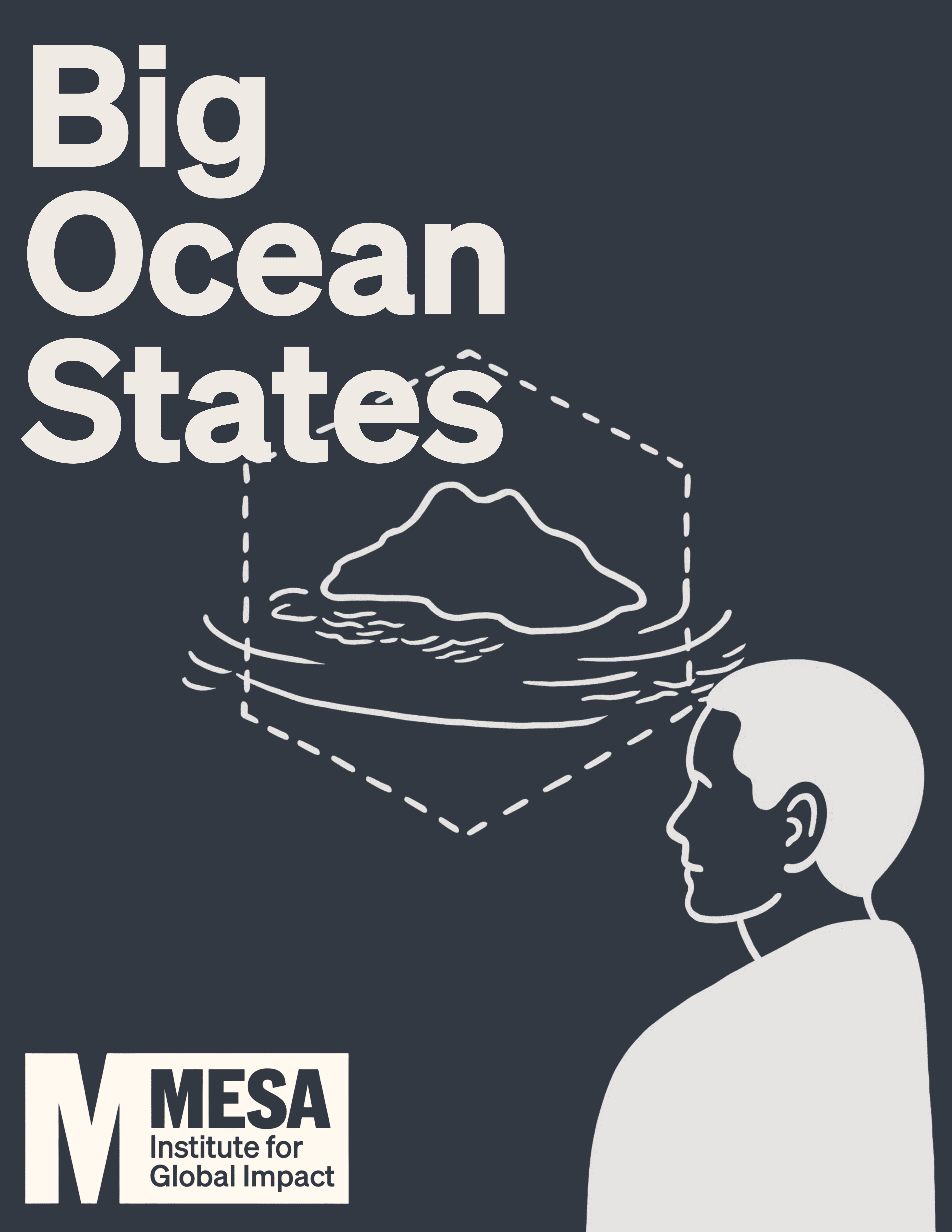
Today’s “small island state” categorization does not fit the global role that Caribbean states like Saint Lucia and Saint Kitts and Nevis, Pacific states like Vanuatu and French Polynesia, and Arctic states like Greenland play in the world order. They are big ocean states. The best way to illustrate this needed paradigm shift is by looking at the map of the Pacific. While it is hard to spot the islands on a conventional map due to their limited land mass, a map of exclusive economic zones reveals that the Pacific is nothing but a continuum of these exclusive economic zones.
That is why Columbia University Professor Jenik Radon and I introduced a new definition of big ocean states into the literature: a big ocean state is defined as a state or territory whose exclusive economic zone in the ocean is significantly bigger than its inhabitable land mass and whose culture is therefore ocean centric.
This definition finds broad support among big ocean states. “We are often called small island states, but we consider ourselves big ocean states. When you look at French Polynesia, it's quite obvious. We have approximately 4,500 square kilometers of land, and then we have 5 million square kilometers of ocean.”, says President Moetai Brotherson of French Polynesia. This sentiment is echoed by Prime Minister Terrance Drew of Saint Kitts and Nevis: “The reason we want that shift is to help people understand that the sea belongs to us as well.”
Our definition also highlights an aspect that is too often overlooked when dealing with big ocean states: the ocean centric culture. “Our connection to the ocean is something essential to us. There's no separation of land and ocean in the traditional Polynesian culture. It's just a continuum.”, emphasizes President Brotherson.
This seemingly minuscule semantic shift from small island states to big ocean states massively advances our understanding of the role of these states, as this article will highlight. This includes the areas of climate change, economic development and the multilateral order.
Big impact on the global fight against climate change
Big ocean states bear a particularly heavy burden of the impacts of global climate change. While the Caribbean is being hit by increasingly strong hurricanes that can wipe out the GDP of an entire big ocean state within hours, Pacific big ocean states such as Tuvalu face severe impacts from rising sea levels.
Adaptation is therefore an essential element of policy making in big ocean states, as Prime Minister Drew highlights: “We are building out our resilience. We are now in the process of building homes that can withstand Category 5 hurricanes and more. We are also in the process of building a brand-new hospital that can sustain a Category 5 hurricane”. The rising sea-level also impacts the drinking water sources of big ocean states “We have invested heavily in water. Now, we need to go to desalination because of sea-level rise - it’s now infiltrating our aquifers. We are losing them, so now we have to go to desalination.”, says Prime Minister Drew.
Big ocean states can leverage indigenous experiences for the adapting to a changing climate, as Vanuatu’s Climate Change Minister Ralph Regenvanu highlights: “We are indigenous peoples with a long history of adaptation to climate change, thousands of years living in the islands where we are. We’re building on those solutions while recognizing that there are limits to adaptation. We need the world to act as well.”
Big ocean states have therefore been a major advocate for far-reaching measures to fight climate change. Vanuatu has most recently made global news and history by successfully leading the push for a new instrument in the toolbox of mitigation and adaptation, an advisory opinion by the International Court of Justice. This unanimous advisory opinion says that states can be held legally accountable for their greenhouse-gas emissions.
Climate Change Minister Regenvanu highlights the grassroots start of this groundbreaking approach: “The idea for seeking an advisory opinion from the ICJ actually came out of a law class at the University of the South Pacific in Port Vila. (…) There was an assignment given by the lecturer, saying, “If you could think of a single measure as lawyers that could make the greatest impact on this climate crisis we are facing - what would it be?” And they came up with this idea of seeking an advisory opinion.”
Big impact on the global economic system
Big ocean states have increasingly been at the center of key global economic debates, from fisheries to critical minerals and energy.
The biggest economic sector for most big ocean states is the fishing industry. “The most important resource besides the human resource is the fisheries. You could say that almost 100% of every export that we have is from fisheries”, says Aaja Chemnitz, the Greenlandic MP of the Danish national parliament. That is why big ocean states like Greenland work on diversifying their economies
“Greenland has to make a living out of its resources, right? We have our fishing stock, which is very important and will continue to be a big driver and economy. Then we have nature of course, so tourism is also a big driver in our economy. And then we look to, of course, the mineral sectors.”, says Greenlandic Minister of Natural Resources Naaja Nathanielsen.
In the Pacific, the issue of the mineral sector plays out in the debate on deep-sea mining. Some Pacific big ocean states see deep-sea mining as the key element of economic development. Other big ocean states and the vast majority of member states of the International Seabed Authority advocate for a continuation of the moratorium on deep-sea mining to establish a scientific understanding of its impacts.
“The Cook Islands are undergoing a process in partnering with a Canadian mining company to establish the amount of those polymetallic nodules that are on the seabed in their EEZ and they are in favor of deep-sea mining. So, we don't have a unique position on this issue and we need to discuss it very seriously because we are all neighbors and I don't think that pollution knows administrative barriers.”, highlights President Brotherson his position to continue the moratorium and engage with big ocean states on this issue. This approach is echoed by Prime Minister Drew: “We intend to protect our maritime space. Sustainable development is the foundation of how we explore it.”
To facilitate future economic development to avoid the need for income from deep-sea mining, big ocean states need to tackle a key underlying issue: high electricity prices. And “When you examine fossil fuel, for example, which is a big issue for people on the island, it is very expensive and obviously, we are trying to move into other areas of renewable energy to diversify our energy supply options.”, says Foreign Minister Baptiste.
That is why Prime Minister Drew has made efforts to lower electricity prices and expand renewable energies one of the priorities of his presidency of the Caribbean Community in 2026. “We have a lot of natural energy resources in the region - wind, sun, geothermal and waves. This energy is cheaper than any other source. We in the Caribbean pay the highest cost for electricity from fossil fuels in the world - 30 to 40 U.S. cents per kilowatt hour. The U.S. pays 3 to 4 cents. Look at the difference. So, from a purely economic standpoint, exploiting our renewable energy sources will help the Caribbean advance significantly.”
Big impact on the global multilateral system
Given today’s increasingly multipolar world order, big ocean states work on diversifying their foreign relations. “Whilst we are not turning away from our traditional friends, we need to move into a direction where we can create an improved framework for us to match our basic need with greater possibilities.”, says Foreign Minister Baptiste of Saint Lucia.
For Caribbean big ocean states that are members of the Caribbean Community, a particular focus is on strengthening their cooperation and collaboration with African states. “We are the sixth region of the African Union, becoming an official part of that family. In terms of strengthening South-South cooperation between CARICOM and the African Union - the total value of our trade is only about 1%. So, just from a purely economic perspective, there’s a lot of room for growth.”, says Prime Minister Drew. From January 1st on, he will work on this relationship in the rotating role as President of CARICOM.
In addition to new and strengthened bilateral relations, big ocean states work within the multilateral institutions to make their voice heard. Having successfully completed the effort to achieve the previously mentioned advisory opinion, Vanuatu is now working on enacting it within the UN system, as Minister Regenvanu emphasizes: “That’s really what we’re doing here in New York: trying to build that alliance of like-minded states to support a resolution that tries to embed the centrality of international law in dealing with climate change and also the centrality of international law around human rights as a key aspect of how we should be dealing with climate change.”
Conclusion
The new narrative for a changed global order is based on a seemingly minuscule semantic shift to the term “big ocean states”. As this article has highlighted, it greatly advances our understanding of the role of these states, in the areas of climate change, economic development, the multilateral order and far beyond.
FIND MORE
